> ## Documentation Index
> Fetch the complete documentation index at: https://docs.praxis-ai.com/llms.txt
> Use this file to discover all available pages before exploring further.
# Conversation History
> Your digital twin's working memory for the current conversation — and the Remember History setting that controls it
AI models don't inherently remember previous messages — each request is processed independently. To keep a conversation coherent, Pria includes your recent exchanges with every new prompt, so the model can follow references like *"add the error codes section"* without you re-explaining what you're working on.
That context isn't free: every included exchange adds to the tokens processed per request. The **Remember History** setting is your control over the balance between context depth and cost.
Only includes exchanges from the current conversation — unrelated threads never bleed in
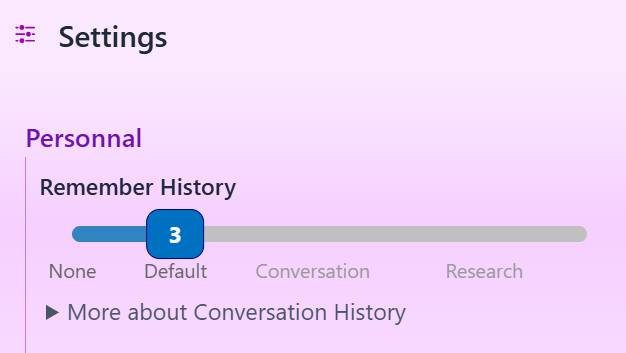
A slider from 0 (no history) to 15 dialogue exchanges; the default is 3
More history = more tokens per request (1 credit ≈ 10,000 tokens)
At 6 or higher, older exchanges are automatically summarized to keep costs down
***
## Adjusting Remember History
Open the sidebar and find **Remember History** under the **Knowledge** sub-menu (it's also in your profile's Conversation Preferences). The slider runs from **0 to 15** with named marks: **None (0)** · **Default (3)** · **Conversation (6)** · **Research (12)**.
 | Use case | Suggested setting | Why |
| -------------------------------- | ----------------- | ------------------------------------------------------- |
| **Quick, independent questions** | 0–3 | Minimal context needed; cheapest |
| **Everyday conversation** | 3–6 | Good continuity at reasonable cost |
| **Code development / writing** | 6–10 | References earlier snippets, style, and decisions |
| **Complex research or analysis** | 10–15 | Deep multi-step context; compaction keeps it affordable |
Setting it to **0** turns history off entirely — every prompt stands alone. Handy for batches of unrelated one-shot questions.
***
## What it costs
Every exchange included in history adds its tokens to each new request. As a rough illustration: if each exchange averages 2,500 tokens, a setting of 8 adds \~20,000 history tokens to every prompt — about 2 credits before your new question is even counted.
Three habits keep costs in check:
* **Match the setting to the task** — high for deep work, low for quick questions.
* **Start a new conversation when the topic changes** — unrelated history is pure waste.
* **Store lasting preferences in [User Memory](/mdx/user-guide/memory/user-memory)** instead of repeating them in chat — memory parameters cost almost nothing compared to carried history.
***
## Smart history compaction
When Remember History is **6 or higher**, Pria automatically compacts older history instead of sending it word-for-word:
* Your **3 most recent exchanges** are always included verbatim — full detail on what you just discussed.
* **Older exchanges are summarized** into a concise context block that preserves key topics and decisions at a fraction of the tokens.
* Summaries are **reused between requests** in the same conversation, so follow-ups don't pay to re-summarize the same history.
* If compaction is ever unavailable, your full history is used instead — nothing breaks.
**Example:** with the setting at 12 and 12 exchanges in the conversation, sending everything verbatim might cost \~30,000 history tokens per request. With compaction, exchanges 1–9 compress to \~3,000 tokens plus \~7,500 verbatim for the last three — roughly a **65% reduction** with no visible difference in how the AI responds.
Because of compaction, **6–8** is a sweet spot for general use and **10–12** for complex projects — you get long-range context without the proportional cost.
***
## Boundaries
* **Each conversation keeps its own history** — starting a new conversation starts a clean context.
* **Assistants don't share history** — switching assistants switches threads.
* **History is distinct from User Memory** — history is the recent back-and-forth; [User Memory](/mdx/user-guide/memory/user-memory) is the durable facts Pria keeps about you across all conversations.
***
## Troubleshooting
| Symptom | Likely cause | Fix |
| --------------------------------------------- | -------------------------------------------------- | ------------------------------------------------------------------------------------ |
| Pria forgets what you said a few turns ago | Setting too low, or you started a new conversation | Raise Remember History |
| Token usage feels high for simple questions | Setting too high for the task | Lower the slider, or start a fresh conversation per topic |
| Pria references an unrelated earlier topic | Long mixed-topic conversation | Start a new conversation for the new topic |
| Pria keeps asking for your role / preferences | Those belong in long-term memory, not history | Tell Pria to *remember* them — see [User Memory](/mdx/user-guide/memory/user-memory) |
***
## Related
* [Memory Systems](/mdx/user-guide/memory/memory-systems) — how the three memory types fit together
* [User Memory](/mdx/user-guide/memory/user-memory) — durable personal facts and preferences
* [Shared Memory](/mdx/user-guide/memory/shared-memory) — team-wide knowledge for a Digital Twin
* [Credit Optimization](/mdx/user-guide/credits-optimization) — more ways to stretch your credits
| Use case | Suggested setting | Why |
| -------------------------------- | ----------------- | ------------------------------------------------------- |
| **Quick, independent questions** | 0–3 | Minimal context needed; cheapest |
| **Everyday conversation** | 3–6 | Good continuity at reasonable cost |
| **Code development / writing** | 6–10 | References earlier snippets, style, and decisions |
| **Complex research or analysis** | 10–15 | Deep multi-step context; compaction keeps it affordable |
Setting it to **0** turns history off entirely — every prompt stands alone. Handy for batches of unrelated one-shot questions.
***
## What it costs
Every exchange included in history adds its tokens to each new request. As a rough illustration: if each exchange averages 2,500 tokens, a setting of 8 adds \~20,000 history tokens to every prompt — about 2 credits before your new question is even counted.
Three habits keep costs in check:
* **Match the setting to the task** — high for deep work, low for quick questions.
* **Start a new conversation when the topic changes** — unrelated history is pure waste.
* **Store lasting preferences in [User Memory](/mdx/user-guide/memory/user-memory)** instead of repeating them in chat — memory parameters cost almost nothing compared to carried history.
***
## Smart history compaction
When Remember History is **6 or higher**, Pria automatically compacts older history instead of sending it word-for-word:
* Your **3 most recent exchanges** are always included verbatim — full detail on what you just discussed.
* **Older exchanges are summarized** into a concise context block that preserves key topics and decisions at a fraction of the tokens.
* Summaries are **reused between requests** in the same conversation, so follow-ups don't pay to re-summarize the same history.
* If compaction is ever unavailable, your full history is used instead — nothing breaks.
**Example:** with the setting at 12 and 12 exchanges in the conversation, sending everything verbatim might cost \~30,000 history tokens per request. With compaction, exchanges 1–9 compress to \~3,000 tokens plus \~7,500 verbatim for the last three — roughly a **65% reduction** with no visible difference in how the AI responds.
Because of compaction, **6–8** is a sweet spot for general use and **10–12** for complex projects — you get long-range context without the proportional cost.
***
## Boundaries
* **Each conversation keeps its own history** — starting a new conversation starts a clean context.
* **Assistants don't share history** — switching assistants switches threads.
* **History is distinct from User Memory** — history is the recent back-and-forth; [User Memory](/mdx/user-guide/memory/user-memory) is the durable facts Pria keeps about you across all conversations.
***
## Troubleshooting
| Symptom | Likely cause | Fix |
| --------------------------------------------- | -------------------------------------------------- | ------------------------------------------------------------------------------------ |
| Pria forgets what you said a few turns ago | Setting too low, or you started a new conversation | Raise Remember History |
| Token usage feels high for simple questions | Setting too high for the task | Lower the slider, or start a fresh conversation per topic |
| Pria references an unrelated earlier topic | Long mixed-topic conversation | Start a new conversation for the new topic |
| Pria keeps asking for your role / preferences | Those belong in long-term memory, not history | Tell Pria to *remember* them — see [User Memory](/mdx/user-guide/memory/user-memory) |
***
## Related
* [Memory Systems](/mdx/user-guide/memory/memory-systems) — how the three memory types fit together
* [User Memory](/mdx/user-guide/memory/user-memory) — durable personal facts and preferences
* [Shared Memory](/mdx/user-guide/memory/shared-memory) — team-wide knowledge for a Digital Twin
* [Credit Optimization](/mdx/user-guide/credits-optimization) — more ways to stretch your credits